
Workplace Drug Testing Matters
What urine, hair, and saliva can (and can’t) tell you about safety, behavior, and performance.
Modern workplace drug testing didn’t appear out of thin air. It was pushed into the mainstream by a mix of safety disasters, federal action, and culture. In the 1980s, the National Transportation Safety Board documented fatal transportation accidents where substance impairment was a causal factor. One widely cited example is the 1987 Chase, Maryland train collision, where the Safety Board reported a marijuana-impaired freight train engineer failed to heed a signal—resulting in 16 deaths and 170+ injuries. Federal action included Ronald Reagan’s executive order establishing a “Drug-Free Federal Workplace” framework, reinforced by the “Drug-Free Workplace Act of 1988,” which required certain federal contractors and grantees to maintain drug-free workplaces as a condition of receiving awards. Culturally, Nancy Reagan helped popularize the “Just Say No” anti-drug campaign, which became an iconic part of the era’s prevention messaging.
When testing started, the drug test positive rate was over 13%. Today, in the general workforce, the positive rate is around 5%, and in well-run, effective programs, it can be less than 1%. This has a profound impact on workplace safety and productivity.
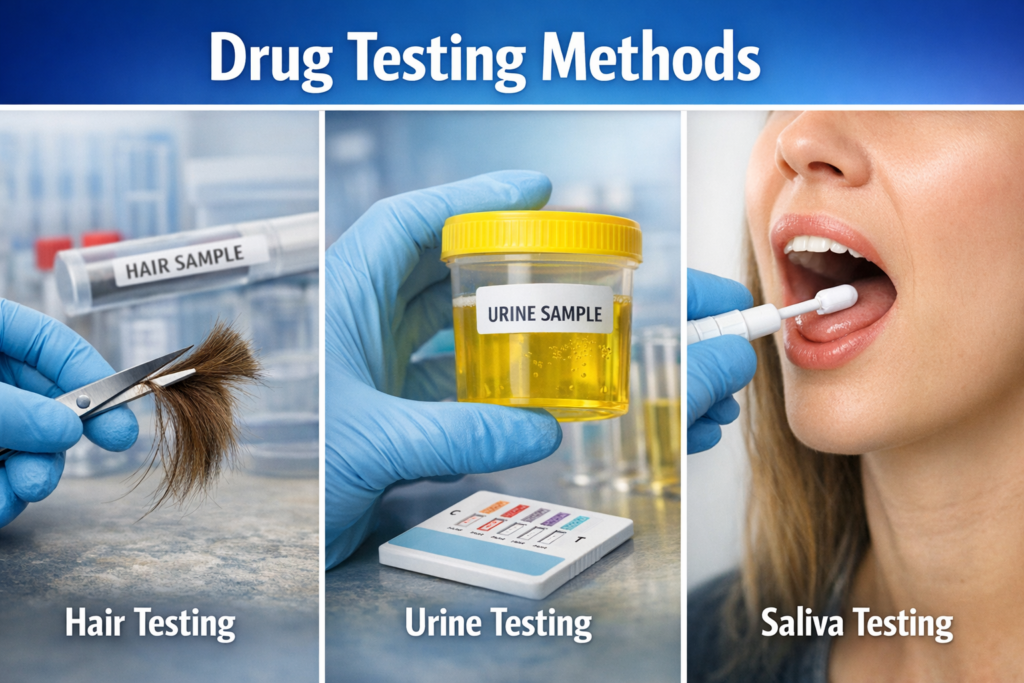
There are various ways to conduct drug testing. Determining which method will work best for your organization depends on several factors. The chart provided here is intended to provide you with basic information to support your work with your testing administrators, legal counsel, and organizational leadership as you develop or revise your drug testing program.
| Category | Urine | Hair | Oral Fluid (Saliva) |
| Best Use | Recent detectable use | Pattern of use over weeks or months | Recent use – proximal to collection |
| Window of Detection | Days for most drugs, longer for marijuana, and chronic use | Weeks to months – generally about 90 days | Hours – very recent, up to approximately 48 hours |
| Advantages | Strong federal guidelines and framework | Long window of detection and no bathroom necessary | Observed collection reduces substitution, is not invasive, and is practical after an accident |
| Drawbacks | Tampering possible, privacy re: collection, doesn’t indicate current impairment | Contamination risk, decontamination necessary, doesn’t indicate current impairment | Shorter window of detection, detection level not correlated to impairment |
| Federal Cutoffs Established | Yes, regulated testing uses SAMHSA/HHS guidelines for screening and confirmation | No | Yes, oral fluid panel cutoffs are specified by SAMHSA and HHS |
| Defensible | Yes, when done in line with regulatory guidance, screening, confirmation & Medical Review | Yes, when analytical lab methods are used, and decontamination protocols are rigorous | Strong, when the chain of custody is followed, and confirmation is done by a laboratory |
| Best Testing Occasions | Commonly used for all testing occasions | Best for pre-employment, random, and follow-up | Post-accident, and reasonable suspicion |
| Adulteration Possible | Yes, must have strict collection guidelines, and specimen validity testing | Substitution unlikely, concern regarding external contamination | Substitution unlikely, collection guidelines required, and equipment adequately maintained |
| Privacy Concerns | Yes, particularly for observed collections | No, but viewed as unpleasant | No, but awkward |
| Infer Impairment | No | No | A short detection window can align better with recent use |
| Appropriate for Federally Regulated Testing | Yes, the primary historically used specimen | No | Not yet! |
| Turnaround Time and Legal Defensibility | With Lab confirmation and Medical Review, this is the standard. Rapid screens alone are weaker | Like Urine – as long as the chain of custody, validated lab methods, and contamination controls are maintained | Defensibility improves with lab-based confirmation testing, device control, and strict protocols |
If you’d like to discuss your testing program, review your procedures, or update your policy, please contact Luci Manos at ScreenSafe, Inc.